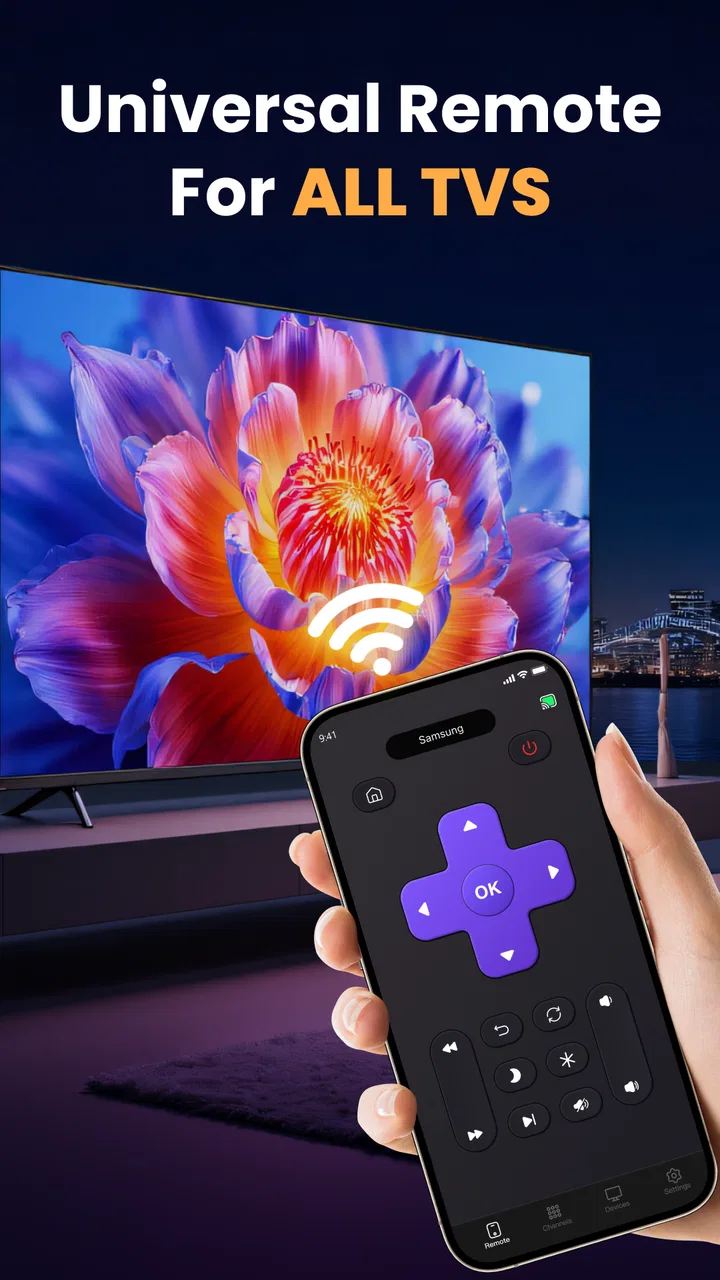
TV Remote Control For All TV
- 4.3
- Rating
- 1.00M
- Installs
- Free
- Price

 Analysis by App-foxy
I tried TV Remote Control For All TV as a practical Tools app rather than treating it like a novelty remote, and my first impression was straightforward: it aims to make the phone useful when the physical controller is missing, misplaced, or simply inconvenient. That sounds simple, but the real value depends on how quickly it responds when you are already sitting down, whether it remains dependable during longer viewing sessions, and whether your television is compatible with the way the app communicates.
Created by Brandon Scout, the app is free and intended for everyone. It had reached over 500 thousand installs and holds a 4.3 average from around 5 thousand ratings, which suggests that many people find the basic idea worthwhile. I would describe it as a focused remote-control utility, not a complete smart-home platform. That distinction matters: it is most appealing when you want a phone to handle everyday television controls without carrying another dedicated device.
What using the remote feels like in everyday situations
The most convincing use case is an ordinary one. I can imagine sitting on the sofa, realizing the remote is in another room, and reaching for my phone instead of interrupting the program. The same applies when the controller has disappeared between cushions, when its batteries are exhausted, or when several people are sharing a television and nobody wants to search for the original remote. In those moments, a simple interface is more valuable than a long feature list.
You May Also Like

 Blood Strike: 2.5 Anniversary
Blood Strike’s Loadouts Turn Every Drop Into a Tactical Gamble
A close look at Blood Strike’s custom loadouts: how fast access to signature weapons reshapes its battle royale rhythm, rewards preparation, and narrows the gap between fights.

 Pandora - Music & Podcasts
Pandora’s Music Is Easy to Start, but Harder to Recover
Pandora’s strength is its low-effort path from a seed to a station. Its weak spot is how much confidence it asks you to place in connection, setup, and quiet recovery.

 8 Ball Pool
 Is Built on Rivalries, Rematches, and Routine
A close look at the rivalries, rematches, shared routines, and unanswered safety questions that turn a quick pool match into a persistent mobile community.

 Samsung Music
’s Quiet Strength Is Playing What You Already Own
Its reach comes less from spectacle than from dependable access to a personal library. That simplicity is both the app’s strongest retention engine and its ceiling.

 AccuWeather: Weather Radar
AccuWeather Review: A Quick, Clear Forecast for Everyday Decisions
For everyday plans, the best forecast is the one you can understand quickly. AccuWeather makes rain timing, radar, and local conditions easy to act on, with a few trade-offs.

 Hill Climb Racing
Why Hill Climb Racing Still Turns Crashes Into One More Run
A tiny car, a bumpy hill and one more upgrade: Hill Climb Racing keeps resurfacing because its simple chaos makes every near-miss feel personal.
More From Our News Desk



The short description, “TV Remote Control,” is accurate but not especially revealing. The broader promise is control of smart televisions from a phone, and that makes the setup experience more important than the wording suggests. A remote app has to feel immediate. If opening it, locating the television, or sending a command becomes a chore, the convenience disappears quickly.
In my experience with this kind of tool, the best approach is to prepare it before you actually need it. Install it while the physical remote still works, keep the television powered on during the initial connection, and test basic actions such as power, volume, and navigation. That small preparation step is one of the most useful habits with any phone-based remote because troubleshooting is much harder when the television is already off or inaccessible.
The app is also a reasonable option for households where the original controller is confusing or overloaded. A phone can be easier to find and easier to keep nearby. On the other hand, it is not automatically better for every person. Someone who dislikes using a touchscreen for tactile controls may still prefer physical buttons, especially in a dark room where it is difficult to confirm what the finger is touching.
Speed expectations and the feel of a phone-based controller
Speed is not only about how fast an app opens. For a remote, it is the time between tapping a control and seeing the television react. I found that the experience is most satisfying when I use it for deliberate commands: changing the volume, moving through a menu, pausing content, or switching between inputs. Those actions feel natural on a phone when the connection is already ready.
The important qualification is that a phone remote is not identical to an infrared controller. Its responsiveness can depend on the television, the local connection, and the phone itself. I would not judge a delayed response as proof that the interface is poor without first checking whether the television is awake and connected. A command can also appear ineffective when the screen is busy loading or when the television has changed state.
My practical advice is to tap once and give the command a moment before tapping repeatedly. Repeated presses are a common source of frustration with remote apps because several delayed commands may arrive together. That can turn a single volume adjustment into an exaggerated jump or move a menu farther than intended. A calm, single-tap rhythm is especially useful during navigation.
The app is better suited to normal control than to rapid-fire input. If you are entering a long password, scrolling through a large catalog, or moving quickly through a settings menu, the physical remote may still feel more predictable. A phone screen gives you flexibility, but it does not always provide the same physical feedback as dedicated buttons.
Long viewing sessions and heavier moments
During a short interaction, almost any working remote app can seem successful. The more revealing test is a longer evening in which the television is controlled repeatedly. That is when small annoyances matter: returning to the app after checking a message, unlocking the phone, rotating the screen, or finding the correct control after the app has been left in the background.
I see the strongest role for this app in moderate, repeated use rather than constant control. It can be handy for a film night, occasional channel changes, or adjusting volume while seated away from the television. It is less convincing as a replacement for every interaction if you expect to use it continuously for hours and want the same instant physical response from every press.
One useful workflow is to keep the phone in the same place during viewing and open the remote before starting playback. That reduces the number of interruptions caused by unlocking and searching for the app. Another is to use the app for broad actions while relying on the television’s own interface for more involved tasks. This division keeps the remote useful without forcing it to handle every navigation problem.
Resource demands are difficult to separate from the phone and television involved. I would not treat a remote utility as something that should be left running unnecessarily. When I finish using it, closing the session or moving on from the app is sensible, particularly on an older phone. The app’s simple purpose is an advantage here: it does not need to become the center of your device usage.
Heavy use also exposes a trade-off between convenience and battery dependence. A traditional remote can work without asking you to unlock a phone, while this app depends on the phone being charged and available. If your battery is nearly empty, using the phone as the only television controller is a poor plan. I recommend keeping the original remote accessible even if the app becomes your preferred option.
Reliability, reconnection, and recovery
Reliability is the area where expectations should remain realistic. A phone remote can be dependable once the television and phone recognize each other, but a connection may need attention after the television restarts, the home network changes, or the phone has been away for a while. That does not make the app useless; it simply means that the first troubleshooting step is often reconnection rather than repeated tapping.
If a command does nothing, I would work through a short recovery routine. First, check that the television is powered and responsive with its own controls. Next, make sure the phone is connected to the same local environment required by the television. Then close and reopen the remote app, and try a basic command rather than a complex menu action. This sequence avoids wasting time blaming the wrong part of the setup.
A particularly important habit is to test recovery before an important viewing moment. If you plan to use the phone during a presentation, a family gathering, or a night when the original remote is unavailable, test the connection earlier in the day. A remote app is most valuable when it is already proven on your television, not when it is being installed in a hurry.
I also would not assume that every television behaves identically. “All TV” in the name expresses the intended breadth, but compatibility in practice can vary by model, operating system, connection method, and network arrangement. The safest expectation is that the app may work well with a compatible smart television, while an older or unusual setup may require more patience or may be better served by its original controller.
Recovery is easier when you avoid changing several things at once. If the app stops responding, do not immediately reset the television, reinstall the app, and alter network settings together. Make one change, test one control, and note what happened. That method is slower for the first minute but much faster when you need to identify the actual cause.
Device constraints that can change the experience
The app requires Android 11 or later, so the phone itself is the first compatibility checkpoint. This is not an issue for a recent device, but it matters if you are hoping to reuse an old phone as a permanent remote. A phone that cannot install the current version is not helped by the app’s otherwise convenient concept.
The current version is 1.3.0, released on July 4, 2025. I would keep the app updated through the normal store process, especially for a tool whose success depends on communication between two devices. Updates can matter more for utilities than people expect because a television platform or phone operating system may change independently of the remote app.
Screen size is another practical constraint. On a large phone, controls are easier to identify and tap accurately. On a compact screen, a crowded remote layout can make navigation less comfortable, particularly for users with limited vision or less precise touch control. I would test the most frequently used buttons first rather than assuming that every control will feel equally comfortable.
The television’s own state matters as well. A remote app is not a magic replacement for every physical function if the television is completely disconnected, frozen, or unable to communicate. If the television cannot receive the relevant signal, no phone interface can solve that by itself. This is why I see the app as a convenient companion and backup, not as a reason to discard the original remote immediately.
There is also a social constraint that is easy to overlook. A shared television may be controlled by several people, but the app lives on one person’s phone unless everyone installs and configures it. That can be useful for personal control, yet less convenient in a household where different family members need access. A physical remote remains simpler to hand from one person to another.
How it compares with the usual alternatives
The obvious alternative is the television’s original remote. It wins on tactile feedback, independence from phone battery, and immediate access. It is also the safer choice for someone who frequently uses directional controls in darkness or needs to operate the television without unlocking a device. If those are your priorities, this app should be a backup rather than a full replacement.
A manufacturer-specific remote app may be preferable when you own one television brand and want deeper integration. Such an option can sometimes feel more tailored to that television’s menus and services. The appeal of Brandon Scout’s app is broader convenience: it is aimed at people who want one general-purpose tool rather than a separate application for every screen in the home.
Universal physical remotes occupy the middle ground. They offer buttons and can control multiple devices, but they require pairing, storage, and sometimes manual configuration. A phone-based remote avoids another piece of hardware, which is a meaningful advantage in a small room or temporary accommodation. The trade-off is that the phone is now part of the control chain.
I would choose this app over those alternatives when I regularly misplace the remote, want a free backup, or need to control a compatible smart television from the sofa without buying another accessory. I would choose the original remote when the television is unreliable on the network, the phone is often unavailable, or tactile buttons are essential. That is the clearest way to understand its place: useful convenience, not universal superiority.
Who should install it, and who should skip it
This app makes sense for people with a compatible smart television, a phone running Android 11 or newer, and a preference for reducing clutter. It is particularly practical for students, renters, guest rooms, and households where the remote regularly goes missing. Because it is free and rated for everyone, there is little financial or age-related barrier to trying it.
I would be more cautious if your television is old, your home connection is inconsistent, or you need guaranteed control at all times. People who operate a television for accessibility reasons should test the touch controls carefully before relying on them. A physical remote may remain the better option if button shape, pressure, or tactile orientation is important.
It is also not the right choice if you expect a phone remote to replace a full smart-home system. The app’s value is focused: putting television control on the phone. If you need coordinated control of lights, speakers, streaming boxes, and other equipment, a broader platform may be more appropriate, even if it involves more setup.
My performance verdict after weighing convenience against friction
My overall view is positive but measured. TV Remote Control For All TV succeeds as a focused utility because it addresses a common annoyance with a free phone-based alternative. The 4.3 average and over 500 thousand installs indicate that the idea has found a substantial audience, while the current version shows that the app is still being maintained as a contemporary Android tool.
The strongest part is the convenience of having a remote available without searching for another object. The weakest part is the dependence on compatibility, connection state, and phone availability. Those are not minor details; they determine whether the app feels instant or frustrating in a particular home.
My recommendation is to install it as a tested backup first. Pair it while the original remote is nearby, try it during both a quick command and a longer viewing session, and keep the physical controller until you know how recovery works on your television. If the connection remains stable and the touch layout suits you, it can become your everyday remote. If not, it still may be worth keeping for emergencies.
My final judgement: choose it for convenient smart-TV control from a newer Android phone, but keep realistic expectations about compatibility and recovery. It is a sensible free tool for the right setup, not a guarantee that every television will respond exactly like a dedicated controller.
FAQs for TV Remote Control For All TV
01Is the TV Remote Control For All TV app compatible with all TV brands?
The TV Remote Control For All TV app is designed to support a wide range of TV brands, including popular ones like Samsung, LG, Sony, and Panasonic. However, compatibility can vary depending on the model and year of your TV. It's recommended to check the app's compatibility list or the app store description to ensure your specific TV model is supported.
02Do I need an internet connection to use the TV Remote Control For All TV app?
While an internet connection is not required for basic remote control functions, some features may need Wi-Fi to work. For example, accessing smart TV apps or streaming content may require an internet connection. Ensure your phone and TV are connected to the same Wi-Fi network for optimal performance.
03Are there any in-app purchases or ads in the TV Remote Control For All TV app?
The app may offer a free version with ads and optional in-app purchases for an ad-free experience or additional features. It's important to check the app's description in the app store for details on what is included in the free version versus the premium version.
04How easy is it to set up the TV Remote Control For All TV app?
Setting up the app is generally straightforward. After downloading, you'll typically need to pair your phone with your TV, usually via Wi-Fi or infrared, depending on your device's capabilities. The app usually provides a step-by-step guide to help you through the process, making it user-friendly even for beginners.
05Can the TV Remote Control For All TV app replace my physical TV remote entirely?
While the app can perform many functions of a physical remote, there might be some limitations depending on your TV's features and the app's capabilities. Functions like voice commands, gesture controls, or unique brand-specific buttons might not be fully supported. Always keep your physical remote as a backup.
Pros
- Easy to set up with most TV brands.
- Intuitive user interface for smooth navigation.
- Supports voice commands for convenience.
- Customizable remote layout options.
- No need for multiple remote controls.
Cons
- Contains ads that can be intrusive.
- Limited functionality on older TV models.
- Requires stable Wi-Fi connection.
- Some features locked behind a paywall.
- May experience occasional lag or delay.

TV Remote Control For All TV
Gallery